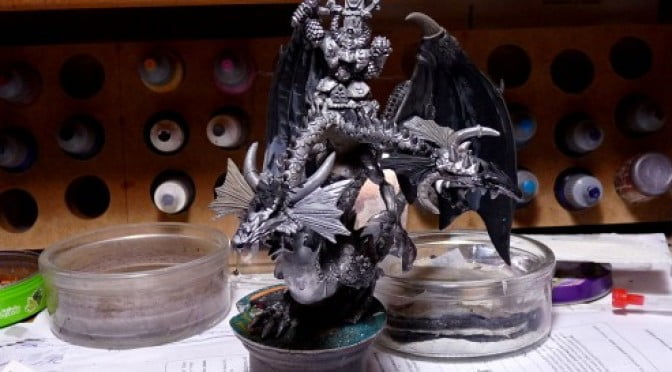
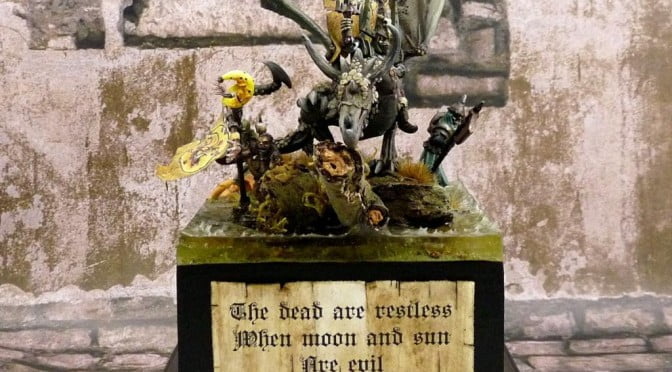
This time it’s definitely not as much as I’d like to present but considering my recent lack of time I shouldn’t complain. Last night my I managed to spend 30 mins with trusty Dremel gizmo and finally one of my fav models (EVAH!) is assembled:
Egrimm van Horstmann mounted on Chaos dragon.
The model will be based on similar size plinth as the Zombie dragon but I don’t want another swamp (I will save it for something more undead…). No matter the surface will be fantasy-urban or something natural there will be Skaven running in the tunnel below, so looks like there’s lotta heavy drilling ahead. But first something more trivial: filling lots of gaps… =/
This is a story of one gift. A story of one lady and three dragons. A very special lady, I should add.
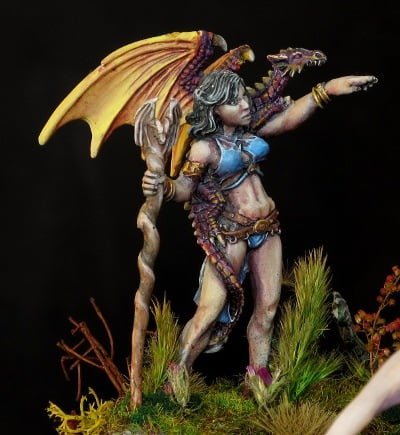
Where to start… Oh well, long time ago I had planned a big diorama under the working title of “City of Dragons”. However, the only piece I painted for it was this dragon lady (Reaper Master Series Miniatures – 54mm scale). As you can see, it was supposed to be a statue with a small dragon on it, not a live female.
The concept I’d had for this new diorama did not involve any statues, so I had to repaint this model. Black and white base I had on the lady made me go with glazing all over. Very thin layers of heavily watered paint were used on almost every part of the miniature. The shadows and highlights were already there, all I had to do was adding a colour to it.
The small dragon was treated in a different way, obviously, I’ve just pulled the highlights up here and there.
With that, the first part of my dio was ready:
The second part of my dio is also a salvaged piece. Dragon lady came with this additional dragon (though it is also available separately in Reaper range as DHL 3332), which was initially used by me for this scene:
I’d dismounted it from the base, gave it few additional highlights, and here it is, the second part of my new diorama:
The last piece as also a Reaper mini and was painted from a scratch. It is the Shadow Dragon (Bones plastic range, but also available in metal) and initially was supposed to be painted as a black dragon. After some consideration I thought the black colour and size of the model would make him stand out too much on a dio, so I decided to paint him red. Unfortunately, I couldn’t get reds working right on this model, so after few attempts I gave up and switched to another colour that you can see below. The final result had been achieved by using violet liner and white to build up the base which was then glazed over with light blue. Wings were painted with violet liner and tanned skin shades (plus some white for final highlights). Frankly, I’m quite pleased with the result.
The third part of a dio:
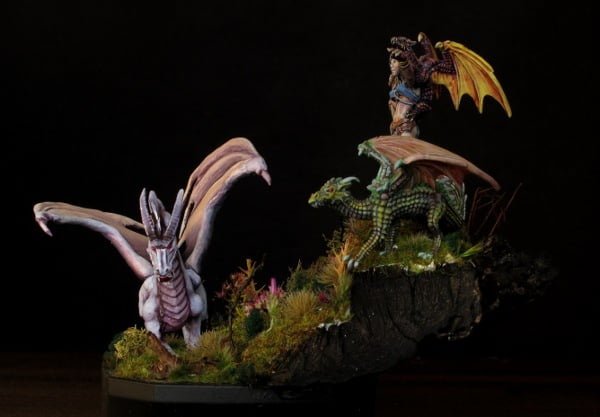
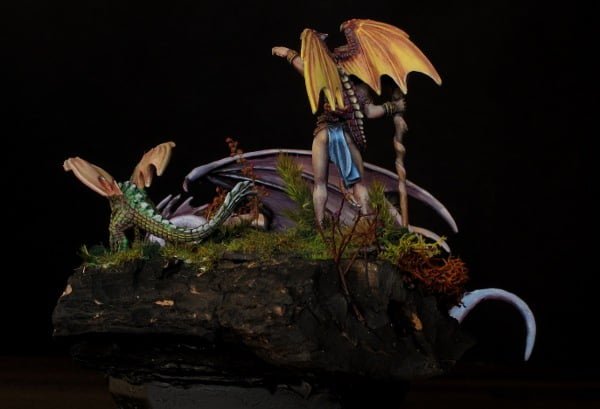
With 2 parts salvaged from my other dioramas, repainted and/or improved, and one brand new piece I was finally able to put them all together. Of course, I had had the concept ready and the whole scene had been carefully planned before I started painting. I had the base and I arranged minis on it as the first step of my work. So, after I’d finished painting all I had to do was to assemble models on the base (piece of wood on a “plinth” made of a plastic cap taken from a coffee jar). I tried to arrange models on two levels so that viewers can see all details from different angles. Finally, a lot of static grass, twigs and dried greenery was added to create a nice, spring/summery feel to it.
Of course, every dio requires a story, but I prefer to leave that task to viewers. Feel free to come up with your own.
My story? There Be Dragons was painted as a birthday gift for my wife. So, what I’ve painted is actually our family – my lady and her three men. One big and old dragon (that would be me, of course), one small dragon on his own feet (8 yo son) and another small dragon that still requires to be carried around ( 2nd son, 10 months).
By the way, my wife almost never comes into my painting room. When she does, she never asks what I’m painting at the moment. Both of us prefer to show/see the finished mini. So, I have been working on this diorama for over a month, trying to use every spare moment. When I was literally 10 minutes from finishing the gift, she catches me totally off guard by jumping suddenly into the room, taking a look and asking “What are you painting?” Oh well, there went the surprise element…
“North of the Kingdom of the Dead, and east of Worlds Edge Mountains, lies the Plains of Bones. The land is a desert of multi-coloured refractive sand from which huge rib-cages emerge.
For this is the place where dragons came to die, to rest their bones among those of their ancestors as they had done for millions of years, before any other sentient being walked the surface of the Known World…”
It took me long time but I am more than happy to see that beast finished.
Sure lots of things could’ve been done better bur screw it – it’s the first dragon I painted and it made me proud =]
Now don’t you think that Chest of Colors is only a painters community! We game and we love pictures of painted units doing their best on table tops. Here at our forum we’ve got a special section called Tale of Gamers, and our friend Arctica posted his Pirate Orks there for us all to see.
Tale of Gamers – what is it about?
In this part of forum any member (if brave enough 😉 ) can start his own tale. Every thread is devoted to one miniature project. There are no deadlines, no gaming system restrictions and everyone sets his own point goal. As an example it can be:
2250 points Ultramarines army for Warhammer 40000
200 points Lost war band for Hell Dorado
45 points Khador battle group for Warmachine
any Malifaux or Freebooter’s Fate skirmish band
Space Hulk, Dreadfleet or maybe Super Dungeon Explore… own point goal
And yeah – you can start as many tales as you wish 🙂 The point of a Tale of Gamers is to motivate each other to paint and finish collections of models.
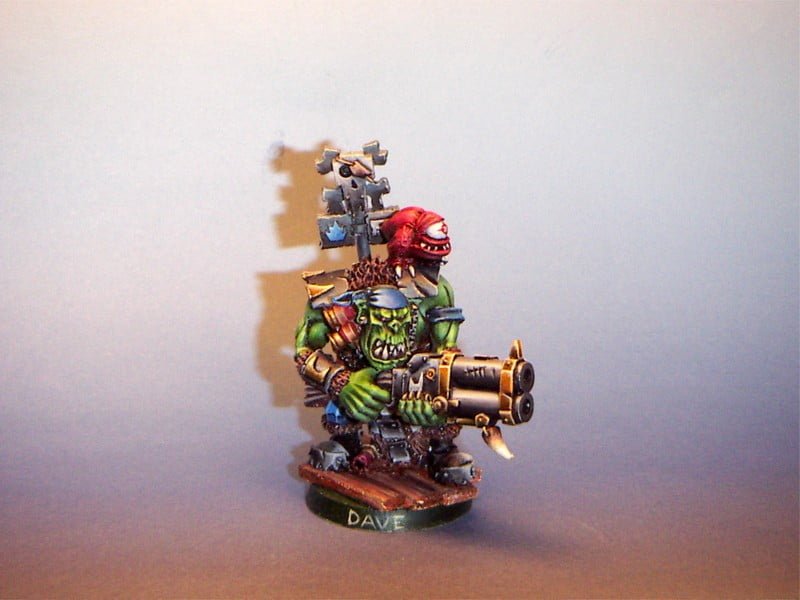
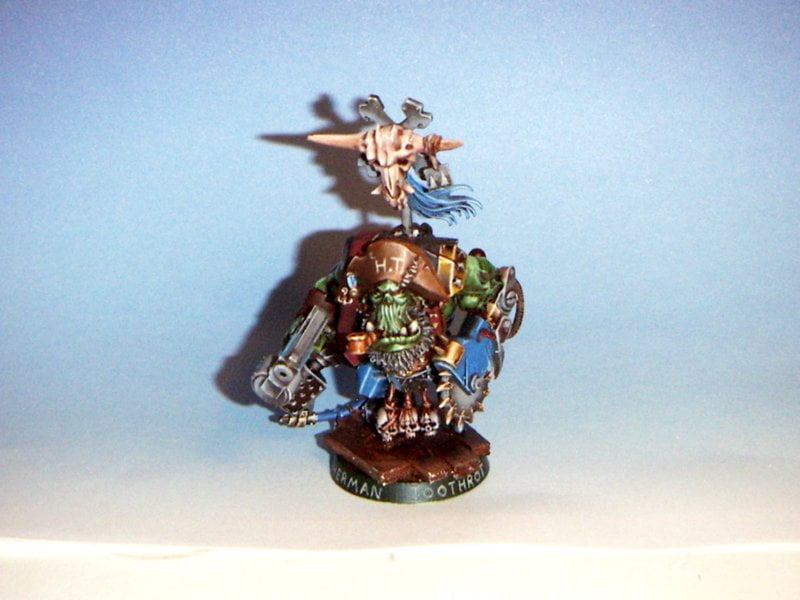
To show you an example of such a Tale, let’s take a look at Arctica‘s Pirate orks, and read what he said about this project:
Pirate Orks by Arctica
So I first came up with the idea of ork pirates when my friends started playing Necromunda, they wanted me to get involved and join in. So I looked through the current range of models and actually I was not really a fan of any of the gangs so I decided to make a customized gang.
Since I’ve always liked orks but knew there were too many for me to do a sensible force this seemed a good opportunity and the release of the conversion bits for ork pirate heads seemed liked a good time to try this project.
Pirate orks assembled
Plans and preparations
I put the models together and primed them and decided to go for a slightly different approach to the models to break up my usual state of painting. So going for a white primer rather than a black one was to challenge myself and see why other painters took this route.
After painting the first miniature I found it super fun and I was really excited to actually move onto the next model. The encouragement of the painting community here on Chest of Colors miniature painting forum and my own eagerness pushed me through the whole gang very very quickly. My original intention was to use the ork gang to break up any monotonous army painting but I quickly found that the orks were much more interesting than anything else and so I focused everything on them.
In many ways I would say that having 1-2 projects on the go is a good thing but I think for those exceptional projects you never need more than that one. And I kept posting my work up and getting group shots of the whole lot being completed one at a time made me really feel good about a project so I kept rolling with all that drive and motivation and pushed the project to completion very rapidly.
I always have plans for many things, but for now I have plenty of Warmachine models I want to finish so that I can compete at tournaments etc. I have another gang idea floating about but I need to work a few things out first.
If you would like to see Arctica’s tale or even comment it, here is the link to it.
Watch the progress
The most interesting part in having a tale is to watch the progress of an growing army. Here is an example how Arctica did it.
End of the Tale
Enjoy the photos of each member of pirate crew.
Pirate orks warband ready for gaming!
Join us – start your own tale!
Did you know that painted miniatures do on table top battlefields much better? And for sure they look better on the shelf. 🙂
So are you a gamer? Does the possibility to play with painted miniatures motivates you to paint? Join other painters that try to turn metal piles of lead soldiers into battle ready killing machines. We help, comment and discuss about our armies and the most important we motivate each other.
Remember, there are no rules or strict schedules here. This forum section is always open for anyone who wants to challenge himself with any army/war band/ battle group. It is just simple fun helping to win one big prize – your own fully painted army.
And finally: what do you think about this kind of projects? Are they interesting to you? Are they motivating and encouraging? Why don’t you leave a comment to tell us if you want to read about our other tales and share your other suggestions with us. Thank you!
There’s a saying, which is often said to be a Chinese curse: “May you live in interesting times”. Whether it’s a true Chinese curse or not, it doesn’t matter. But one thing is sure – we’re living in interesting times, indeed. Many new technologies made it to our lives and hobbies. Digital sculpting is one of them…
Many people are sceptical to innovations and refuse to treat them on par with the old methods.
Just like with most new technologies, there are as many people fascinated with the new possibilities as others – criticizing it. Not only being critical and sceptical about it, but also refusing to treat it on par with traditional sculpting. And we’ve had an interesting discussion about digitally sculpted miniatures on our miniature painting forum, but let’s start from the very basics.
What is digital sculpting?
You surely know what traditional sculpting is: The sculptor takes a lump of putty or clay and shapes it with his hands and/or sculpting tools. You know the kind of tools used for sculpting, right? You surely do.
Traditional sculpting tools
Now with digital sculpting, the artist forgoes his “physical” sculpting and tools to use a computer and create a “virtual model” with it. You must have heard about 3d modeling – you can see digital 3d models everywhere: in movies, in computer games, on digital artwork, on posters, in advertisements… Often it’s difficult to tell if the object or person was a real one or is it only a virtual creation.
Now one can create such a 3-dimensional model and then “print” it, using one of many 3-d printing services. Or maybe create a mold and produce copies of it. It doesn’t really matter – the clue is that a virtual creation is turned into a physical, tangible object. In our case: a miniature. That’s what digital sculpting of miniatures is all about.
ZBrush – One of digital sculpting tools
I bet you see the difference: “Traditional sculpting” creates a physical object from the beginning, and “digital sculpting” creates a virtual model first, which is given a physical form in the next step(s). And what are the consequences of this difference?
Traditional vs digital sculpting
Digital sculpting can use many benefits of working on a virtual object, many that we know from inage editing software – like “undo”, “copy-paste”, easy texturing, etc. When a sculptor makes a mistake, he can press “undo” and correct his mistake easily. When he wants to create another arm, sword, head, etc. – he can use “copy/paste” and modify the newly created copy. He can also “stamp” textures onto surfaces of his models. There are many many other options in popular 3-d modeling software, but I only wanted to give you a quick insight into the choice of tools the sculptor may use in his digital sculpting.
Copy – Paste: the digital way and the traditional way
On the other hand, traditional sculptors have similar options, but they’re not as easy to use as in digital sculpting. Sure, he can “undo” his mistakes – by cutting off, sanding off, or scratching off the parts he’s not satisfied with. It takes more work than pressing a button, but can be done. Of course, he can “copy and paste” an element he sculpted: he can create a mold and cast a few copies, or maybe create a quick print in greenstuff… But it’s more difficult and time consuming than pressing Control+C Control+V. And yes, he can also stamp textures: create a small textured “stamp” and press it against surfaces before they’re cured. But it’s not as easy and convenient as doing it the digital way.
So what? Does it make a traditional sculptor a better artist (or craftsman) than a digital sculptor?
Text processor vs pen
Is a miniature good because of its creative concept or the tools chosen by the sculptor?
Let’s think about a poet who writes a poem, or a novellist writing a book. Many of them moved on to using computers and text processing tools now. But doesn’t it make their art less impressive? They can use copy-paste, undo, and spellcheckers now. Their friends using pens or pencils do the same, but do it the harder way. Does it make their art better because they had to put more effort into it.
Or is it more about creativity than the choice of tools?
Wait, there’s another example, because the first one was a bit too controversial. Let’s take a painter with oil paints and canvas, another one with a photo camera and traditional darkroom plus a choice of retouching tools (traditional, not digital), and another one with photoshop and computer. They all create images, visual art. They all can create pictures of landscapes.
Was H.R. Giger a worse kind of artist because he used an airbrush?
But is the painter more of an artist than the photographer? And the digital artist less of an artist than the painter?
Or do they create different kinds of art? Although they are all kinds of visual art, they’re all pictures, they’re difficult to compare at all…
Errare humanum est
Or: “To err is human”. Errors and mistakes are a part of our lives and also of our creations. Some say, that imperfections make works of art even more impressive and admirable. You must have read many comments that digital sculpting creates sculpts which are too perfect, too clean, too artificial. That they lack the human touch, the personal touch of the sculptor, which is given by traditional sculptors to their works. Do you agree with this opinion?
Digital model vs. actual casting – Ivanka Kurganova from Raging Heroes
When you take a look at traditionally sculpted miniatures, many of them bear marks of some sculpting imperfections. Sometimes surfaces are not perfectly smooth, details not perfectly symmetrical, and shapes not perfectly modeled. And that makes them special, that makes them unique and gives them the magic touch of the sculptor.
Is it the same with digital sculpting? If people complain it lacks the imperfections of traditional sculpting by the sculptor’s hands, maybe it is the case? Or maybe it’s simply the lack of mastery of digital sculptors? Maybe there are many great traditional sculptors already, because this art (or craft) has many years of tradition already, but digital sculpting is fairly new and people use it not because of the possibilities of creating great sculpts it offers but because of the benefit of saving time and thus increasing productivity? And when time is your priority, it’s difficult to pay more attention to quality.
It’s just a tool
So is digital sculpting a completely different kind of art/craft, or is it only a different tool for sculptors to use. If it wasn’t for progress and innovations we might be still sculpting our miniatures in clay or chiselling them from stone. But now we have many kinds of putties, all with different properties. We have modern casting facilities, we have precise sculpting tools. So maybe digital sculpting is the next step on the same path? Some will move on, some will stay with the techniques they’re more familiar with.
Progress is unavoidable
Just think about painters. Some are still painting their paintings with brushes, some moved on to airbrushing. I bet it was simiar when somebody invented a brush. Some traditionalists must have complained that painting with brushes is not real art, because it’s taking a shortcut, and they kept painting with their fingers or wooden sticks. 😉
Just like every tool, digital sculpting has its disadvantages, too.
And just like with every tool – digital sculpting has its disadvantages, too. You only get to see the physical object when it’s printed. Until then you only see a virtual image of your sculpt. And you see it on a 2-dimensional screen. Now recall all the complaints that there’s no way of depicting a 3-dimensional painted miniature on a computer screen and a flat image. Translate it to sculpting and you know what I am talking about.
Then there’s the frequent complaint about lack of sharpness of digitally sculpted miniatures. Is it a matter of the sculpting or the printing process? I don’t know, but it seems many companies fail to get it done properly for any reason. So as you can see digital sculpting is not the perfect solution to every sculptor’s woes.
Next generation or degeneration?
Will the transition to digital sculpting result in decrease of sculpting skills?
If we think about digital sculpting along the lines of “next generation of sculpting tools”, we may start to worry if it won’t start a process of degeneration of sculpting skills of sculptors who move on to the new tool. Just like many airbrush painters wouldn’t be able to achieve smooth blending on their canvas using only traditional brushes. And just like many photographers would be unable to create a realistic portrait in the way artists of old did it – drawing or painting it. But do they have to?
Do photographers really have to prove they’re skilled painters? Do people who create great art using airbrushes really have to prove their skills with brushes? And do digital sculptors really have to prove their skills with traditional tools and putties?
Does he really have to prove his acting skills? Or better not…
I say: no, they don’t have to, but their art shouldn’t really be compared with traditional art as far as technical perfection goes. When you compare creativity – feel free to do so, but technical aspects are hardly comparable…
Clash of the titans
I am yet to see a digitally sculpted miniature which will impress me more than some traditional miniatures did.
Now there’s a good question: If we compared a great digital sculptor with a great traditional sculptor, would they be able to create comparable works? I mean: equally impressive and appealing to us, miniature painters? I must say I am yet to see a digitally sculpted miniature which will impress me more than the best miniatures sculpted in the traditional way.
There are many great sculptors, who work in the traditional way. Many that I really admire. Kev White with his characterful models and realistic proportions, Tom Meier with his unbelievable skills at detailing his sculpts, Raul Garcia Latorre with his recognizable style, and many more…
Tom Meier – master of detailing. Just look at the decorative patterns he sculpted on a 30mm scale model! No digital sculpting here…
I have seen many great digital 3-d models (many were really awesome!), but I don’t know of any digitally sculpted miniature which would make me go “wow” as much as many traditional sculpts did. But maybe you have seen such miniatures?
Time will tell…
Now we don’t know which way it’s going to go in future. But we can be sure we’re witnessing and experiencing beginnings of a new trend in our hobby. Digital sculpting made achieving many results so much easier, that it’s going to be pursued for many years to come. But will it completely take the place of traditional sculpting in our hobby?
It is quite natural to look for more optimal tools, ones which will allow you to improve your creations and which suit your needs and style better. It’s a natural process, and it can’t be avoided. But let’s think: should it?
It’s natural to look for more optimal tools
I am really curious what you think about the “digital sculpting vs traditional sculpting” subject. Why don’t you share your comments with us. I am sure they will add many new facts to the topic. Thanks in advance!