

One of the most mysterious and impressive techniques used in miniature painting is the enigmatic OSL, which translates to On-miniature Source Lighting. Whether you like it or not is a matter of personal preference, but why shouldn’t you learn how to use this technique? These tips may be useful for this purpose.
I wanted to explain my way of painting light on miniatures. On our forum we had a discussion about Ana’s spellsinger, and it inspired me to writing this article.

General OSL tips
The way of painting light will be explained using my Demon of Chaos for the example. To begin with, we’ll remind several technical things that everybody should know:
- The closer to the light source, the stronger the light, and the shadows too.
- One needs to know what kind of light the source casts: fire – red/yellow, lightbulb – whiteish, etc.
- We’re painting only these fragments of the mini, on which the light would fall in reality.
- The best method of learning this technique is looking at reallife examples or works of other artists, and the metohds of trials and errors. Usually only experience and practice can show you how it’s done, so I am not teaching you any “success guaranteed” method, but only giving you some hints which can be useful.
- Light looks different on different surfaces, eg. leather, metal, porous surface, or smooth surface. On a cloak or other fabric the light will remain matte (check the torn clothes on the demon’s front), while on metal the light would “slide” on the surface (the demon’s weapon).
- Weak light will make weak intensity of the effect, small small reflections, it doesn’t reach far. On the other hand strong light source casts much light, and has better range. It’s up to you to decide on the intensity of the color and its luminance. And the intensity and luminance define the what the reflections will look like and how far from the light source will they be.
- The further from the source, the bigger radius of the light, but lower intensity.
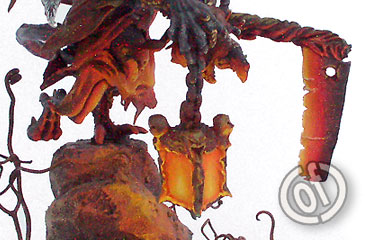
In my humble opinion it’s best to start with painting the mini in any way you like, and only then apply the light and shadows. More work will be needed, but the effect will be better (I know it from my experience). If we start with painting the effect of light, we can en counter various surprising problems, and they will not help us for sure…
Maybe not a step-by-step OSL tutorial
When the mini is painted, we can start painting our light. We’re starting with painting the light source (in this case – from the lamp), which will be helpful when we’ll be painting the reflections.
I started with the darker colors, and I worked toward the lightest point (Fiery Orange, Golden Yellow, Sunburst Yellow, white). We’re keeping the transitions smooth. The reflections can be made with glazes, which will create the natural effect of light falling on the surfaces.
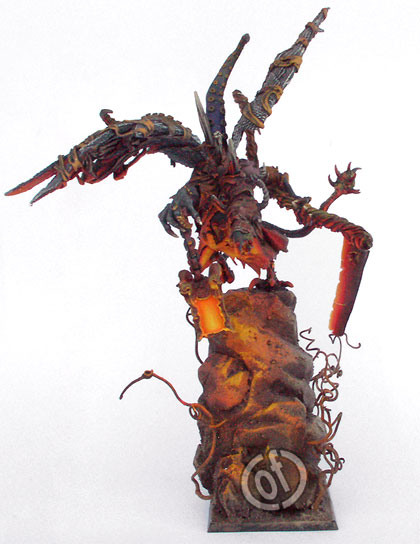
As for the reflections, we’re starting with the surfaces positioned close to the light source, where the reflections will be stronger (the demon’s stomach and head). One can start with a darker color (eg. Blood Red) and mark the places where the light would fall on the whole mini, which will allow us a more complete view of the whole project.
Using glazes for the large surfaces we’re applying successive layers, until the effects satisfies us, but let us keep the color darker than the light source. Glazes will be no good for smaller elements, because thinned paint can run into recesses, etc. And that’s how we paint all the lit surfaces.
The last thing you can do, if there is such need, is making the surfaces opposite to the lit ones darker. I can give you another advice: the reflections near the light source will connct with shadows in a more rapid way: much light – much shadow (eg. the demon’s head). The farther reflections will have more delicate, subtle, and smooth transitions into the local color and then into the shadow (eg. the demon’s tail and tentacles).
And then we can use the same method for the miniature’s base 🙂
One thought on ““C’mon baby, light my fire!” – OSL tips”