Paint rust and chipped paint like a Golden Demon winner

Although historical modelers have been doing realistic weathering for many years already, fantasy and sci-fi miniature painters often lack the knowledge how to paint rust and chipped paint or other kinds of weathering. Stefan Kochowski (Illusionrip), winner of many Golden Demon awards, tells us how he achieves these effects:

In this receipt we’ll make rust for 4 persons, so if you need it for 8 persons just double the proportions.

Preparation: 2 hours

Cost: 50 Polish dollars

Difficulty: not super very difficult ***

[list class=bullet-2]So for this operation we will need:

  • Maskol
  • airbrush
  • Tamiya putty
  • yellow tac
  • 2 hands: one left and one right
  • used brushes but with more or less thin point
  • white primer
  • paints for airbrush
  • 4 sausages with ketchup
  • We begin with priming our object in GW white, in this case I have chosen a Forge World tank dozer blade.
    Normally I would use some Mr Neo surfacer to make the whole object smooth, but today I had no time so we’ll have to make it messy like a piglet……

    Rust and chipped paint - Tutorial

    I would like to make some texture on it, but if you want you could skip this step. For this I use some Tamiya putty. With a big brush I put some putty on a plate, take the putty and just apply it on my blade. Then I’m tapping the putty with my brush, to give it an effect of hard rust attack.

    Rust and chipped paint - Tutorial

    Rust and chipped paint - Tutorial

    After this step, you have to wait about 30 minutes to let the putty dry on your object. While drying take a plate, a fork and a knife. It’s important not to skip this step or you risk having bad rust.
    Then put the 4 sausages and the ketchup on your plate.
    Take the fork and the knife, cut a piece of sausage, put it in the ketchup and then in your mouth, swallow the piece of sausage, and repeat the operation until you don’t have sausages on your plate anymore.

    Now your putty is dry…..

    Rust and chipped paint - Tutorial

    Now we will basecoat our blade with our first rust color.
    So we set up our airbrush, and regulate the flow on a white paper, to avoid mistakes on our object.
    Don’t forget to wash your airbrush scrupulously between applying each different color. The problem with acrylics is that they dry too quickly in an airbrush, so the airbrush could stop working quite quickly.

    Rust and chipped paint - Tutorial

    Rust and chipped paint - Tutorial

    Then we apply our scond layer of rust, a darker one. We won’t apply it on the whole object, but only where the rust could be the oldest. Fresh rust is orange, old rust is more blue dark, so try to find a part of your object where the rust could be the oldest.

    Rust and chipped paint - Tutorial

    Rust and chipped paint - Tutorial

    Now it’s time to use a smelly product called Maskol. You could find it in all modeling shops. This works like a latex tape.

    Rust and chipped paint - Tutorial

    To apply it we will use the sponge technic: Take a piece of green sponge, you know the one who is the hard part of two-layers sponge.
    If your wife or your mother catch you stealing and cutting a piece of sponge, ignore their remarks and just tell them with a totally detached attitude: “You, my dear, don’t understand anything about the art, it is not the artist who is going to the paint but the other way”.
    Use the moment while your mother or wife are trying to understand the sentence you just told them to escape and return to your project. (I can bet that after such a sentence your mother or your wife will have the biggest respect for you.)

    Here is the tool:

    Rust and chipped paint - Tutorial

    With the sponge you take some maskol and tap it on a tissue to remove the most of Maskol (more or less like in the the drybrushing technique).

    Rust and chipped paint - Tutorial

    Then you tap your sponge on the blade, and you repeat the operation until you are satisfied with he result. Beware to never use maskol with a brush, because maskol can’t be removed with any thinner, so the brush will definitely go out of order.

    Rust and chipped paint - Tutorial

    Now, we should let the maskol dry, count about 15 minutes. If you have some sausages again, do no hesitate….

    Now we will apply our last layer with an airbrush.
    I use a turquoise color, for this I mixed blue and green/khaki and grey to desaturate the color and then make contrast with the rust.

    Rust and chipped paint - Tutorial

    I apply a darkest first layer on whole he object.

    Rust and chipped paint - Tutorial

    Once it’s dry, apply a second one – lighter and with a little zenithal effect, I mean that I only airbrush it from the top of the object.

    Rust and chipped paint - Tutorial

    Now it’s time to let this bloody rust appear. I use some yellow tac for this, but you could use blue tac or white tac. I think that a rubber eraser could work too, but I haven’t tried.

    Rust and chipped paint - Tutorial

    In fact I use my yellow tac like a gum to remove the liquid mask and then let our rust appear.

    Rust and chipped paint - Tutorial

    Rust and chipped paint - Tutorial

    Now we will give our rust some more volume. Just under it, apply a very thin line of the turquoise color but with a lot of white in it with a fine brush. It will give this aspect of depth to your scratches.

    Rust and chipped paint - Tutorial

    Now we will add rust but with several washes of brown in all the edges, to give our object some deepness and richness. We could simulate some thine line of brown under rivets, to simulate streaks of rust.

    Rust and chipped paint - Tutorial

    And then we will add some glazes of bleached bone to define the different part of the blade.

    Rust and chipped paint - Tutorial

    I hope it will help you, see ya soon,

    Stef.

    How to paint skin like Demon Color

    In response to all the questions about Demon_Color’s way of painting flesh, we are presenting his own description of how he does it… So let him tell us how to paint skin like he does:

    Method one

    The skin on the Ogre is painted in two ways. The first way is with use of my favorite lines. I use lines to paint surfaces where are lots of curvatures and raisings on small areas – for example hands and faces.

    In the beginning we must choose a raised area, for example a muscle. We have to position front and back of the chosen area. On the front of the area, we choose a place where we will start painting our lines. Now with a fast pull we draw a line from the place we have chosen to the back of the surface. Next we continue drawing other lines right next to previous line but just lighter one. After some practice the lines will look dynamic and will give some dynamism to painted in such way surface. Everything depends on predisposition and skills of the painter. Not everyone will be able to paint this way – you have to love lines to get it right.

    Photo: Painting skin - Tutorial

    We must pay attention because painted surfaces can look like naked muscles – in shorter words – our miniature can look like skinned alive. When I look at my earlier miniatures I see that some of them have tendency to “walk without skin” – and a few times I’ve been pointed out about that.

    Method two

    To avoid that I use the other method of painting skin – soft transitions. I use it mainly when painting large, flat surfaces. Everything goes just like with blending, but mainly on semicircle surfaces (in the case of Ogre – blade-bone) I use a characteristic line which will mark out the area of the blade-bone.

    Photo: Painting skin - Tutorial

    Colors used

    For both methods I use the following colors (Vallejo paints):

    1. DARK FLESHTONE nr 44 (GW Bestial brown)
    2. PARASITE BROWN nr 42 (GW Snakebite leather)
    3. sometimes COBRA LEATHER (but rarely) nr 40
    4. sometimes SCROFULOUS BROWN (rarely) nr 38 (GW leprous)
    5. DWARF SKIN nr 41
    6. PALE FLESH nr 3
    7. WHITE

    How to paint faces – Tutorial

    Painting faces is one of the crucial parts in miniature painting hobby. Unfortunately many people give up before even trying to master this skill. This tutorial explains how to paint faces, but in fact it’s much more than that. It also teaches how to use colors for shaping your miniatures, how to create sense of depth with colors, how to make skintones interesting, and how to play with color nuances on your miniatures. To put it shortly: it’s a must-read for every aspiring miniature painter.

    Well, with this I believe that the subject of the faces is complete. In this tutorial I address location of lights and shadows, midtones and tones to heighten and to disguise volumes. In addition it’s expanded with color palettes and tones for different surroundings, specially focused to the four seasons.

    Palettes

    First of all, painting a face is thinking about the palette of colors that im going to use. A very common mistake between painters is to be accustomed to a mixture and to use it for all type of skins. They finish doing monotoneous and little realistic works when they paint faces in particular circustamces. This can be minis under a strong light, bronzed by the sun or when trying to represent figures of different ethnic groups in the same diorama.

    In the picture below it’s possible to observe some palettes that I have created for the occasion. One is a generic palette of brown neutral, very similar to the one I use for base colors, accompanied by other four sets of tones. Two primary pallettes (Warm and Cold) and 2 mixed. The intention is that mixing the palette of generic with the suitable palette of tones we pruned to give the atmosphere that we wish to surround our miniature.

    How to Paint Faces - Tutorial

    The first palette of tones is the one that we will call generic.

    How to Paint Faces - Tutorial

    They are the typical flesh colors that have a neutral tone and that we will turn to warm or cold according to our chioice. Andrea’s flesh paint set, basic skintone (VMC) , brown cork, light flesh could be colors of this type.

    Later we have the palette of warm colors.

    How to Paint Faces - Tutorial

    This palette is the ideal to use in a summer atmosphere since the thermal sensation of its colors evokes the summer period. It uses ochre and orange colors for reddish the midtones and brown tones for the zone of shade. Flesh is illuminated as well with a yellowish color that simulates the direct solar illumination.

    In the opposite side we have the palette of colds.

    How to Paint Faces - Tutorial

    This palette would be adapted for a winter typical scene by the temperature of its colors. One is based on pink for midtones and blue or violet for shades. The illumination is made with a greyish color that does not warm up the lights.

    So how to paint faces with these palettes?

    We can see a compared example of both palettes in this digital painting recreation (miniature was only digitally painted).

    How to Paint Faces - Tutorial

    How to Paint Faces - Tutorial

    The mixed palettes correspond to mixtures between cold and warm colors. Indeed spring and autumn match in their intermediate temperature so we are able to use them indifferently.

    The spring palette that I have taken is this:

    How to Paint Faces - Tutorial

    This composing in its majority by cold colors since my intention is to intone with the intense green color of the leaves at this time. The midtones will be of a pink-orange tone and the shades will go in fucsia. The lights became a little grey applying some greenish tone to the skintone to simulate the dragged pallor of the winter.

    Finally the autumn palette, that is the following one:

    How to Paint Faces - Tutorial

    Composed in its majority by warm colors to intone with the leaves of fall and a cold touch that represents the temperature of the atmosphere. It uses a pink color to simulate the cheeks attacked by autumn cold. The rest of colors: ochre and brown game with the landscape of withered leaves.

    Once we selected the color palette to use, there is another aspect to consider. On many occasions the “flesh” colors are colors very saturated to represent the average tones and it’s better to grey them a little to obtain a greater realism. (It is not the case of the miniature that I painted, since the gray tone is present as much in average tones as extreme.)

    Here I put an example in a figure by Vincenti for you (that’s realism):

    How to Paint Faces - Tutorial

    Placing highlights and shadows

    In the miniature where the positioning of lights and shades will be explained (Space Marine). I decided to grey all the face and then to heighten the volume giving tones. For the base I used the second base of the Andrea’s flesh paint set who has an intense orange brown color. I toned the color down by adding azur that is approximately the complementary color. Once applied the base it is the moment for adding the lights and the shades. Each face is different but more or less there are certain elements that all have in common. There are zones that always will be in shade and zones which always will be in light and this with some practice you will learn to see it automatically. The light focus is very advisable, for aesthetic reasons, to turn it a little to give more realism and to personalize the face. Its convenient before establishing the incidence of the light to locate the main view of the figure to adequate the light focus to that view.

    How to Paint Faces - Tutorial

    Once illuminated and shaded the face has a too uniform aspect to seem real (independently of the used color). By applying additional tones we will cause that the face takes realism and in addition we will be able to give depth or to heighten volumes alternating cold colors and warm colors.

    Manipulating volume

    The theory is that the warm colors tend to heighten a volume, to say it somehow, to push it towards outside. On the contrary the cold colors give to sensation of depth and/or concavity. If we have this in mind its easy applying glazes of cold and warm colors to heighten the reliefs of the figure. Here you have a small example.

    How to Paint Faces - Tutorial

    Once we learned this it’s necessary to assimilate what we have learned and not to directly associate prominent parts with warm colors and parts sunk with cold colors. The good thing of this technique is that indeed it helps us to emphasize volumes and to make hollows deeper but also allows the opposite. If we have an unwanted volume we can apply the cold tone to disguise a protuberance and the warm tone to minimize a depression.

    The perfect example is the figure of Lyssete, 28mm of Reaper Miniatures. It is a precious miniature that aside from having the typical Werner Klocke face has a noticeable cheekbone. I’ve selected a few photos so that you can see it for yourselves.

    How to Paint Faces - Tutorial

    How to Paint Faces - Tutorial

    How to Paint Faces - Tutorial

    The challenge is in countering the hard gesture that has modeled the figure. In order to obtain it in this case I have used orange colors (my dear German orange) around the cheekbone, that in a normal figure would intone in cold color to mark it. Doing so I have been able to disguise a little the deep hollow that existed.

    Later the challenge is in being able to disguise volume that it leaves downwards from cheekbone and that it is so ugly in a feminine face. In this case I need to “sink” the zone but I cannot use blue or green colors since probably they would give a sensation of a beard. I decided to use fucsia color to cool it. This tone does the function to me of cold tone and a similar color with the one of a feminine cheek with slight make up. Therefore using it to make up the eyelids will give me coherence to these tones.

    Here you can see the result.

    How to Paint Faces - Tutorial

    How to Paint Faces - Tutorial

    The mini is still unfinished but I believe that the effect can be seen. As always all the questions will be welcome and serve so that everybody understands it better.

    Morsi

    “C’mon baby, light my fire!” – OSL tips

    One of the most mysterious and impressive techniques used in miniature painting is the enigmatic OSL, which translates to On-miniature Source Lighting. Whether you like it or not is a matter of personal preference, but why shouldn’t you learn how to use this technique? These tips may be useful for this purpose.

    I wanted to explain my way of painting light on miniatures. On our forum we had a discussion about Ana’s spellsinger, and it inspired me to writing this article.

    General OSL tips

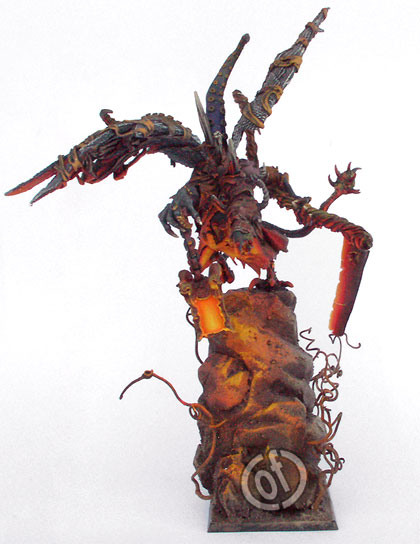
    The way of painting light will be explained using my Demon of Chaos for the example. To begin with, we’ll remind several technical things that everybody should know:

    • The closer to the light source, the stronger the light, and the shadows too.
    • One needs to know what kind of light the source casts: fire – red/yellow, lightbulb – whiteish, etc.
    • We’re painting only these fragments of the mini, on which the light would fall in reality.
    • The best method of learning this technique is looking at reallife examples or works of other artists, and the metohds of trials and errors. Usually only experience and practice can show you how it’s done, so I am not teaching you any “success guaranteed” method, but only giving you some hints which can be useful.
    • Light looks different on different surfaces, eg. leather, metal, porous surface, or smooth surface. On a cloak or other fabric the light will remain matte (check the torn clothes on the demon’s front), while on metal the light would “slide” on the surface (the demon’s weapon).
    • Weak light will make weak intensity of the effect, small small reflections, it doesn’t reach far. On the other hand strong light source casts much light, and has better range. It’s up to you to decide on the intensity of the color and its luminance. And the intensity and luminance define the what the reflections will look like and how far from the light source will they be.
    • The further from the source, the bigger radius of the light, but lower intensity.

    Photo: OSL tips - Tutorial

    In my humble opinion it’s best to start with painting the mini in any way you like, and only then apply the light and shadows. More work will be needed, but the effect will be better (I know it from my experience). If we start with painting the effect of light, we can en counter various surprising problems, and they will not help us for sure…

    Maybe not a step-by-step OSL tutorial

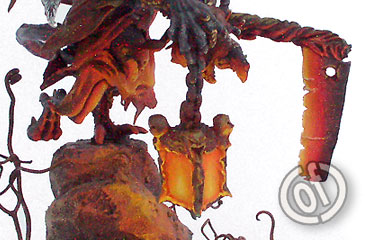
    When the mini is painted, we can start painting our light. We’re starting with painting the light source (in this case – from the lamp), which will be helpful when we’ll be painting the reflections.

    I started with the darker colors, and I worked toward the lightest point (Fiery Orange, Golden Yellow, Sunburst Yellow, white). We’re keeping the transitions smooth. The reflections can be made with glazes, which will create the natural effect of light falling on the surfaces.

    Photo: OSL tips - Tutorial

    As for the reflections, we’re starting with the surfaces positioned close to the light source, where the reflections will be stronger (the demon’s stomach and head). One can start with a darker color (eg. Blood Red) and mark the places where the light would fall on the whole mini, which will allow us a more complete view of the whole project.

    Using glazes for the large surfaces we’re applying successive layers, until the effects satisfies us, but let us keep the color darker than the light source. Glazes will be no good for smaller elements, because thinned paint can run into recesses, etc. And that’s how we paint all the lit surfaces.

    The last thing you can do, if there is such need, is making the surfaces opposite to the lit ones darker. I can give you another advice: the reflections near the light source will connct with shadows in a more rapid way: much light – much shadow (eg. the demon’s head). The farther reflections will have more delicate, subtle, and smooth transitions into the local color and then into the shadow (eg. the demon’s tail and tentacles).

    And then we can use the same method for the miniature’s base 🙂

    And now something about BLOOOOOD!!!!!!!!!!

    In the days of old it was good enough to splatter some red paint on your miniatures and consider it well-painted blood. These days people have higher expectations, so if you want to learn how to paint blood in a realistic and impressive way – just follow the tutorial

    If we want to achieve the effect of dripping blood we need: Tamiya Clear Red paint, Uhu glue, black paint (one can also use some brown or blue).

    Photo: Painting blood - Tutorial

    We apply our “ingredients” onto a piece of plastic, an old CD, etc.

    Photo: Painting blood - Tutorial

    We mix it with a stick or toothpick (it would be a shame to waste a paintbrush).

    Photo: Painting blood - Tutorial

    And now we apply our “ketchup” onto blades/swords/jaws of monsters (the glue wil stretch like a spiderweb).

    Photo: Painting blood - Tutorial

    And when everything is dry you can apply some glossy varnish. Enjoy bleeding. ;-D

    PS – This tutorial is published courtesy of CUKIERas and MaxMini.eu.
    Thanks guys 🙂